




How to Check for Arbitrage
Add outcomes and compare to $1; a quick checklist for real-world execution.
An Easy Rule
The easiest way to check for arbitrage is to add the prices of all possible outcomes for a given event, and if the aggregated price is less than $1, you have an arbitrage opportunity. For example, let's say that the "Yes" contract for Gavin Newsom as the 2028 Democratic presidential nominee is trading on Kalshi at 31¢ and Polymarket at 36¢ — that's a pretty big gap. And let's say that the "No" contract is trading at 65¢ on Polymarket.
All possible outcomes for Gavin Newsom as the 2028 Democratic presidential nominee are either "Yes" or "No", so let's add up the prices. 31¢ + 65¢ is 96¢, which is less than $1, so we have an arbitrage opportunity here.
The Math
Not convinced? Well, here's the math to prove this out. Let's say you buy a "Yes" share at Kalshi for 31¢ and a "No" share at Polymarket for 65¢.
- If Gavin wins the nomination in 2028, you win 69¢ on Kalshi since your 31¢ "Yes" share becomes $1, and you lose 65¢ on Polymarket since your "No" share is now worth nothing. 69¢ − 65¢ is 4¢ which means you win 4¢ if Gavin wins the nomination in 2028.
- If Gavin loses the nomination in 2028, you win 35¢ on Polymarket since your 65¢ "No" share becomes $1, and you lose 31¢ on Kalshi since your "Yes" share is now worth nothing. 35¢ − 31¢ is 4¢ which means you win 4¢ if Gavin loses the nomination in 2028.
Essentially, you win 4¢ regardless of what happens. Given that you've invested 96¢ and are guaranteed 4¢, you're getting a risk-free 4.16% return. For a deeper look at what can go wrong when executing this across platforms, see our guide to cross-exchange arbitrage pitfalls.
The Risks
This all works great in theory, but in practice, there's a bunch of different factors that you should check for since these variables can eat into that risk free return.
- Confirm it's the same outcome. Ensure that both markets resolve to exactly the same contract (same event scope, same resolution rules, same timeline). Small wording differences can make them different assets.
- Check liquidity & depth. Look at order book depth on both markets. Can you buy the "Yes" shares that you want at 31¢ on Kalshi and buy the "No" shares at 65¢ on Polymarket without moving the price? If not, adjust for slippage.
- Calculate exact fees now. Use the Prediction HuntPrediction.com calculator to get a sense of the fees on each platform. But for the latest, look up current fee schedules on the websites of the relevant platforms. Our platform fee comparison breaks down exactly what each exchange charges.
- Execute both sides as close to simultaneously as possible. If one side fills and the other doesn't, you're exposed to directional risk. It might be a good idea to use limit orders to minimize the risk here.
- Don't forget about taxes. Log every trade for audit/tax. Record timestamps, sizes, prices, and fees so you can compute actual net profit and report correctly.
Frequently Asked Questions
How do you check for arbitrage in prediction markets?
Add up the prices of every possible outcome for the same event. If the total is less than $1.00, you have an arbitrage opportunity. For example, if a 'Yes' contract trades at 31¢ on Kalshi and the 'No' contract trades at 65¢ on Polymarket, the outcomes sum to 96¢ — under $1, so buying both locks in a profit no matter how the event resolves.
What does it mean when prediction market prices add up to less than $1?
Each outcome contract pays out $1 if it wins. If you can buy every outcome of an event for a combined cost below $1, exactly one of them is guaranteed to settle at $1 while the rest expire at zero — so your guaranteed payout exceeds your total cost. That gap is the arbitrage profit, and it exists because two platforms are pricing the same event slightly differently.
How do you calculate the return on a prediction market arbitrage?
Divide the guaranteed profit by your total cost. In the 96¢ example — 31¢ for 'Yes' on Kalshi plus 65¢ for 'No' on Polymarket — whichever way the event resolves, one share becomes $1 and the other becomes zero, leaving you 4¢ ahead. A guaranteed 4¢ on 96¢ invested is a risk-free 4.16% return.
Is prediction market arbitrage really risk-free?
Only in theory. In practice several factors can erase the edge: the two markets must resolve on exactly the same outcome, scope, and timeline; there must be enough order-book depth to fill both sides without slippage; platform fees apply to each leg; and you should execute both sides as close to simultaneously as possible — if one fills and the other does not, you are exposed to directional risk. Taxes also apply to net profit.
What can go wrong when executing arbitrage across platforms?
The common pitfalls are resolution mismatches (small wording differences make the two contracts different assets), thin liquidity that moves the price as you buy, fees that shrink the spread, and one-sided fills that leave you holding directional risk. Using limit orders, checking order-book depth, and calculating exact fees beforehand mitigate most of these. Keep a log of timestamps, sizes, prices, and fees for taxes.
Build with this data
Automate your strategies, create arb bots, or build your own dashboard. Free tier includes 1,000 requests/mo across all prediction market platforms.
Free Trading Tools
View allCompare fees across Kalshi, Polymarket & PredictIt.
Find fair probabilities with the overround removed.
See if a trade has positive EV before you enter.
Convert American, decimal & implied probability.
Combined odds and payouts for multi-leg bets.
Your real take-home after fees and taxes.
Related Posts

Prediction Market Indices: How Event Contract Indexes Work
What a prediction market index is, how Kalshi's political power index works, where equity index perps fit in, and whether a prediction market ETF exists yet.
4 min readRead
What Are Perpetual Futures? Perps Explained for US Traders
Perpetual futures explained: how perps work, what funding rates are, and how Kalshi brought regulated crypto perps to US traders in 2026.
4 min readRead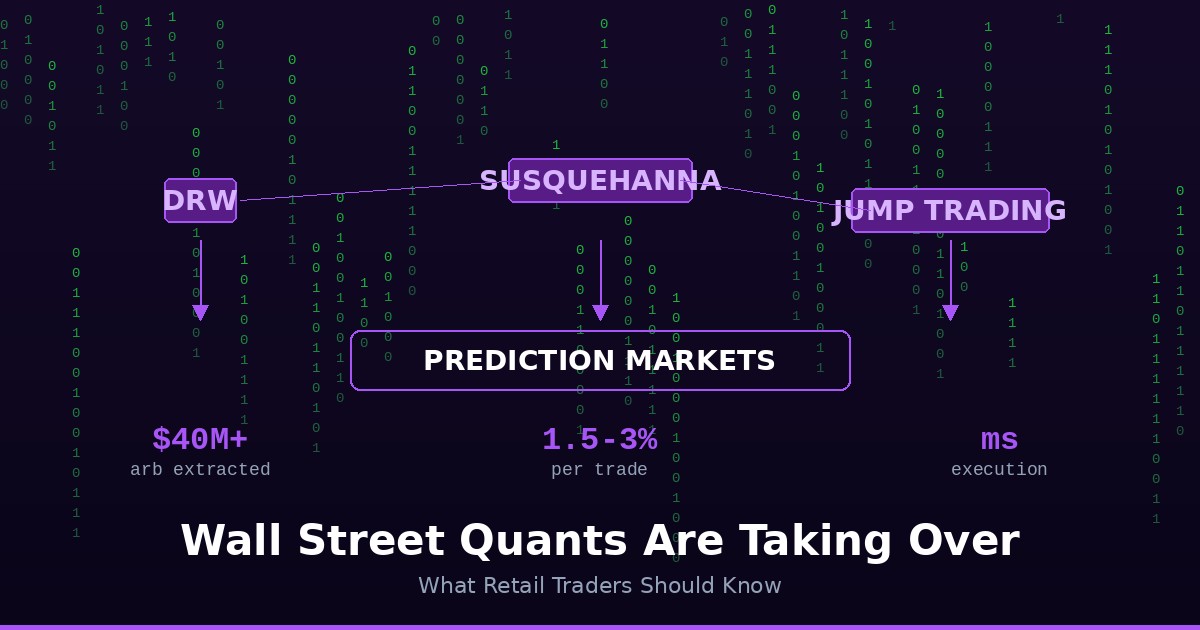
Wall Street Quants Are Taking Over Prediction Markets
DRW, Susquehanna, and Jump Trading are building prediction market desks. How institutional money changes the game — and where retail still has an edge.
7 min readRead