



Liquidity Lies: How Surface Prices Can Mislead Traders
Same price ≠ same trade: depth, spread, stability, and compounding slippage behind the quote.
Two markets might both have the same contract priced at 60 cents, but liquidity could cause the effective price to vary meaningfully. (New to how prediction market pricing works? Start with our prediction markets 101 guide.)
One market might be able to fill 5,000 shares at 60 cents without the price budging — that's easy.
The second market could be trickier though. After buying 50 shares at 60 cents, you might have to buy the rest at 61 cents. It's even possible that you need to purchase shares at 64 cents to get to your goal of 5,000 shares for a contract.
The "60 cents" price you see on the screen can easily turn into something substantially more expensive.
Before you buy contracts, make sure you look into these questions.
- Depth — how much size is really sitting at each price level?
- Spread — what's the distance between best bid and best ask?
In other words, take the time to do the extra math. If you want to buy 5,000 shares, can the market actually fill those 5,000 shares at the current asking price? If not, what price would you be paying for those 5,000 shares? Depending on the liquidity in the market, you could be paying quite a lot more than the surface quote.
Build with this data
Automate your strategies, create arb bots, or build your own dashboard. Free tier includes 1,000 requests/mo across all prediction market platforms.
Free Trading Tools
View allCompare fees across Kalshi, Polymarket & PredictIt.
Find fair probabilities with the overround removed.
See if a trade has positive EV before you enter.
Convert American, decimal & implied probability.
Combined odds and payouts for multi-leg bets.
Your real take-home after fees and taxes.
Related Posts
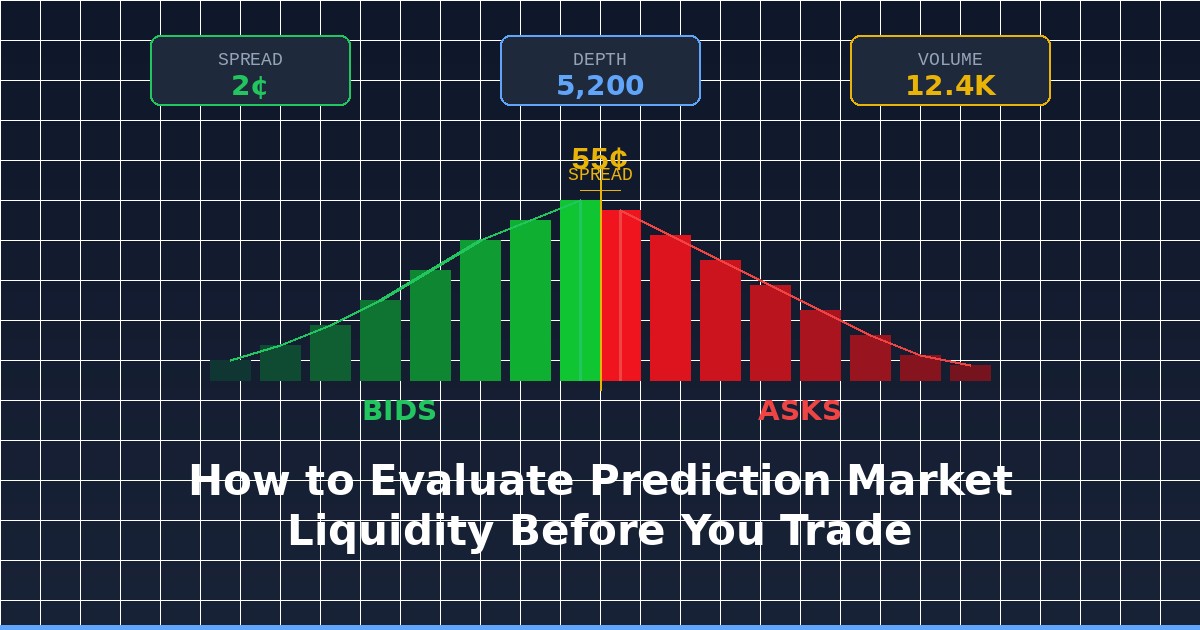
How to Evaluate Prediction Market Liquidity Before You Trade
A practical guide to checking depth, spreads, and fill quality before you commit capital. Stop getting worse prices than you expected.
9 min readRead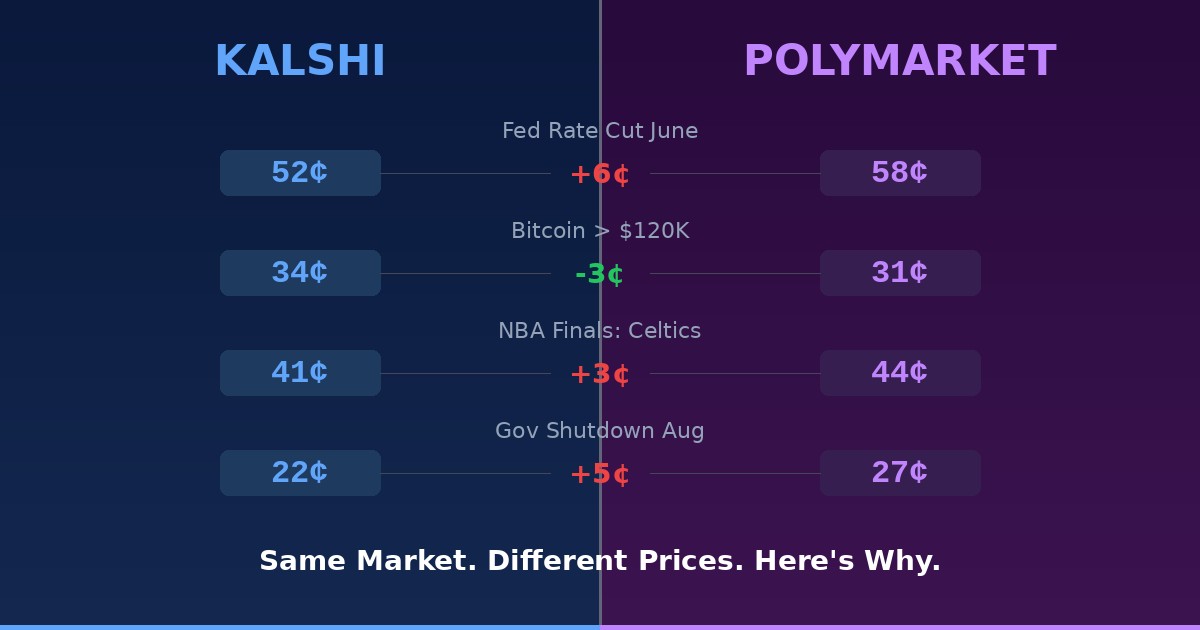
Why Kalshi and Polymarket Price the Same Market Differently
The same question can trade at 52¢ on one platform and 58¢ on another. It's not a glitch — it's liquidity, demographics, fees, and market structure.
7 min readRead
Best Crypto Prediction Markets in 2026
Where to trade bitcoin and crypto event contracts in 2026: Polymarket, Kalshi, Limitless, and Myriad compared on regulation, liquidity, and product depth.
4 min readRead