



Why Kalshi and Polymarket Price the Same Market Differently
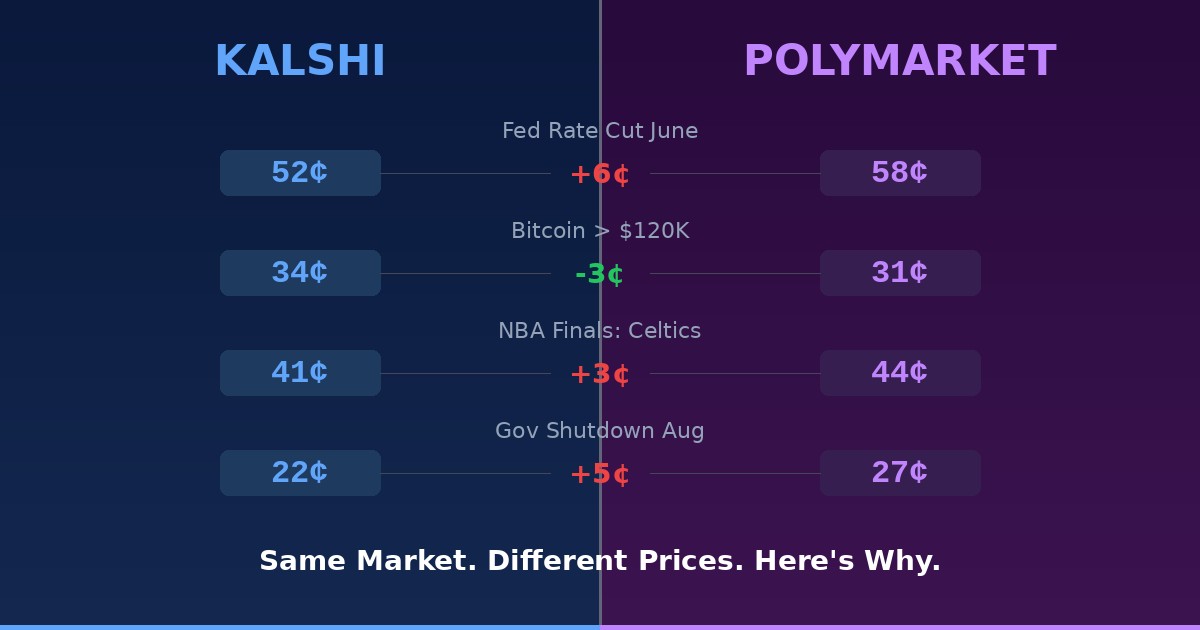
The same question can trade at 52¢ on one platform and 58¢ on another. It's not a glitch — it's liquidity, demographics, fees, and market structure.
TL;DR: When the same event trades at different prices on Kalshi and Polymarket, it's not a mistake. It's the result of different user bases, different liquidity, different fee structures, and sometimes different resolution rules. Understanding why prices diverge is more useful than just chasing the gap.
You're looking at the same contract on two platforms: "Will the Fed cut rates in June?" It's trading at 52¢ on Kalshi and 58¢ on Polymarket. Same question. Same outcome. Six cents apart.
Your first instinct might be to call it an arbitrage opportunity. Sometimes it is. But more often, the gap is telling you something important about how these platforms work — and understanding the mechanics behind price divergence will make you a better trader on both.
Real-world example: In March 2026, "Will the US enter a recession in 2026?" traded at 31¢ on Kalshi and 38¢ on Polymarket — a 7-cent gap driven primarily by Polymarket's international user base pricing global economic fears more heavily than Kalshi's US-centric traders.
Different Platforms Are Different Markets
This is the most fundamental point, and the one most easily overlooked: Kalshi and Polymarket are not the same market. They're separate exchanges with separate order books, separate user bases, and separate market dynamics. The fact that they're asking the same question doesn't mean they'll arrive at the same price — any more than two different stock exchanges would price a cross-listed equity identically at every moment.
Every price on every platform reflects one thing: the balance of buying and selling pressure on that specific exchange at that specific moment. When those dynamics differ — and they almost always do — prices diverge.
Here are the five structural reasons why.
1. Liquidity Depth
The single biggest driver of cross-platform price differences is liquidity — and not just whether a market is "liquid" or "illiquid," but the actual depth at each price level.
A market on Polymarket might show 62¢, but that price could represent 50,000 shares of available depth. The "same" market on Kalshi might show 58¢, but with only 200 shares available before the price moves. The surface prices are 4 cents apart, but the real difference is in how much capital each market can absorb without moving.
Thinner markets are more volatile and more easily moved by a single large order. When you see a big price gap on a less-traded market, it often means one platform has a whale who just moved the price, while the other hasn't reacted yet.
On headline events — major elections, Fed decisions, Super Bowl — both platforms have deep liquidity and prices tend to be within 1-2 cents. On niche markets, 5-10 cent gaps are common and can persist for hours or days.
2. User Demographics
Kalshi and Polymarket attract meaningfully different user bases, and those differences show up in prices.
Kalshi is a CFTC-regulated US exchange. Its users skew toward US-based traders: sports bettors transitioning from sportsbooks, finance-adjacent professionals, and retail traders comfortable with regulated financial products. Kalshi requires full KYC and supports USD deposits via bank transfer.
Polymarket started as a crypto-native platform. While it's expanded well beyond the crypto crowd, its user base still skews more international, more crypto-literate, and more comfortable with decentralized platforms. Deposits happen through crypto wallets.
These demographic differences can create information asymmetries. Anecdotally, Kalshi's user base tends to price US domestic political events more aggressively — likely because its traders skew US-based and politically engaged. Polymarket's user base often shows sharper pricing on crypto-related markets, consistent with its crypto-native origins.
When you see a price gap between platforms, it's worth asking: which user base is more likely to be well-informed on this specific topic? The answer isn't always obvious, but the pattern of divergence can be informative.
3. Fee Structures
Fees affect prices because they affect trader behavior.
Kalshi charges a per-contract fee on winning trades (typically 1-2%). Polymarket's fee structure includes trading fees that vary by market. The details matter less than the principle: different fee structures create different effective prices, even when the displayed price looks similar.
Consider a contract trading at 95¢. On a platform that charges 2% of winnings, your effective cost is 95¢ to win 4.9¢ (5¢ payout minus the fee on your 5¢ gain). On a platform with a flat 1¢ per contract fee, your effective cost is 96¢ to win 4¢. Same displayed price, different expected value.
This effect is most pronounced at the extremes — contracts near 95¢ or 5¢ — where fees represent a larger percentage of potential profit. It's one reason why high-probability contracts (above 90¢) can sustain price gaps that don't represent real disagreement about the event's likelihood. For a detailed breakdown, see our Polymarket fee guide and the fee section of our Polymarket vs Kalshi side-by-side comparison.
You can compare current fee structures on Kalshi's fee page and Polymarket's docs.
4. Resolution Rules
This is the most dangerous source of price divergence, because it looks like arbitrage but isn't.
Two platforms can ask what appears to be the same question but resolve differently based on the fine print. "Will Bitcoin hit $100K in 2026?" might resolve based on:
- Closing price on December 31 vs. any intraday touch at any point during the year
- Coinbase spot price vs. CoinMarketCap aggregate vs. specific exchange API
- A price held for one second vs. sustained for one minute
A 4-cent gap between platforms asking "the same question" might actually reflect the market correctly pricing two different contracts. Before treating a price gap as an opportunity, always check the resolution criteria on both platforms. We covered this in depth in our arbitrage reality check.
5. Timing and Information Flow
Markets don't update simultaneously across platforms. When news breaks, the platform where the most active traders are paying attention will reprice first. The other platform catches up — sometimes in seconds, sometimes in minutes, sometimes longer.
This creates transient price gaps that look like mispricings but are really just information propagation delay. By the time you've noticed the gap, opened both platforms, checked the resolution rules, and placed your orders, the gap may have closed.
Professional arbitrageurs with automated systems exploit these timing gaps in milliseconds. For manual traders, the more useful approach is to recognize that temporary divergences are normal and focus on whether a price gap is structural (driven by the factors above) or transient (driven by information delay).
How to Use Price Differences to Your Advantage
Understanding why prices diverge doesn't just help you avoid false arbitrage — it makes you a better trader.
Shop for the Best Price
Over 200 trades, a consistent 3-cent improvement in entry price is worth $600 on $1 contracts — more than most traders realize. That's not theoretical: it's just the math of checking multiple platforms before committing capital instead of defaulting to whichever tab is already open.
Prediction HuntPrediction.com shows every major market's price across Kalshi, Polymarket, PredictIt, and more — on one screen — so the comparison takes seconds, not minutes.
Read the Signal
When prices diverge meaningfully, ask what it's telling you. If Kalshi's user base is pricing a US political event at 65¢ and Polymarket's more international user base has it at 58¢, maybe the domestic users have better information on this one. Or maybe the international perspective is catching something the US-centric view is missing. Either way, the divergence itself is information.
Understand Your Execution Cost
Don't just compare displayed prices — compare effective prices after fees, spreads, and realistic fill sizes. A market showing 55¢ on Platform A and 57¢ on Platform B might actually be cheaper on Platform B once you account for a wider bid-ask spread on A or higher fees. The liquidity behind the price matters as much as the price itself.
The Bottom Line
Price differences between prediction market platforms aren't bugs — they're features of a market structure with multiple independent exchanges. The gaps reflect real differences in liquidity, user bases, fee economics, and contract specifications.
For most traders, the practical takeaway is simple: always compare prices before you trade. For more analytical traders, the pattern of price divergence across platforms tells you something about who's informed, who's providing liquidity, and where the real edges might be.
Frequently Asked Questions
Why do Kalshi and Polymarket show different prices for the same event?
Each platform is an independent exchange with its own order book. Different user bases, liquidity levels, fee structures, and resolution rules create separate supply-and-demand dynamics. Prices reflect the balance of buying and selling pressure on each specific platform, not a universal "correct" price.
Which platform has more accurate prices?
Neither is inherently more accurate. Accuracy depends on the specific market. Kalshi's US-focused user base may price domestic political events more accurately. Polymarket's crypto-native and international user base may be better on global or crypto-related markets. Higher liquidity generally correlates with more efficient pricing on both platforms.
Can I profit from price differences between platforms?
Yes, but with caveats. True arbitrage requires the contracts to have identical resolution rules, and profits must exceed total fees on both platforms. You also need to execute both sides quickly before prices converge. Use Prediction HuntPrediction.com to monitor cross-platform price gaps and our arbitrage guide to understand the mechanics.
Do prices eventually converge across platforms?
Usually. As events approach resolution and the true probability becomes clearer, prices on all platforms converge toward 0¢ or 100¢. During the life of a contract, arbitrageurs and informed traders push prices toward alignment. However, structural differences — particularly in fee economics and resolution rules — can sustain small gaps throughout a contract's life.
This article is for informational purposes only and does not constitute investment or financial advice.
Build with this data
Automate your strategies, create arb bots, or build your own dashboard. Free tier includes 1,000 requests/mo across all prediction market platforms.
Free Trading Tools
View allCompare fees across Kalshi, Polymarket & PredictIt.
Find fair probabilities with the overround removed.
See if a trade has positive EV before you enter.
Convert American, decimal & implied probability.
Combined odds and payouts for multi-leg bets.
Your real take-home after fees and taxes.
Related Posts
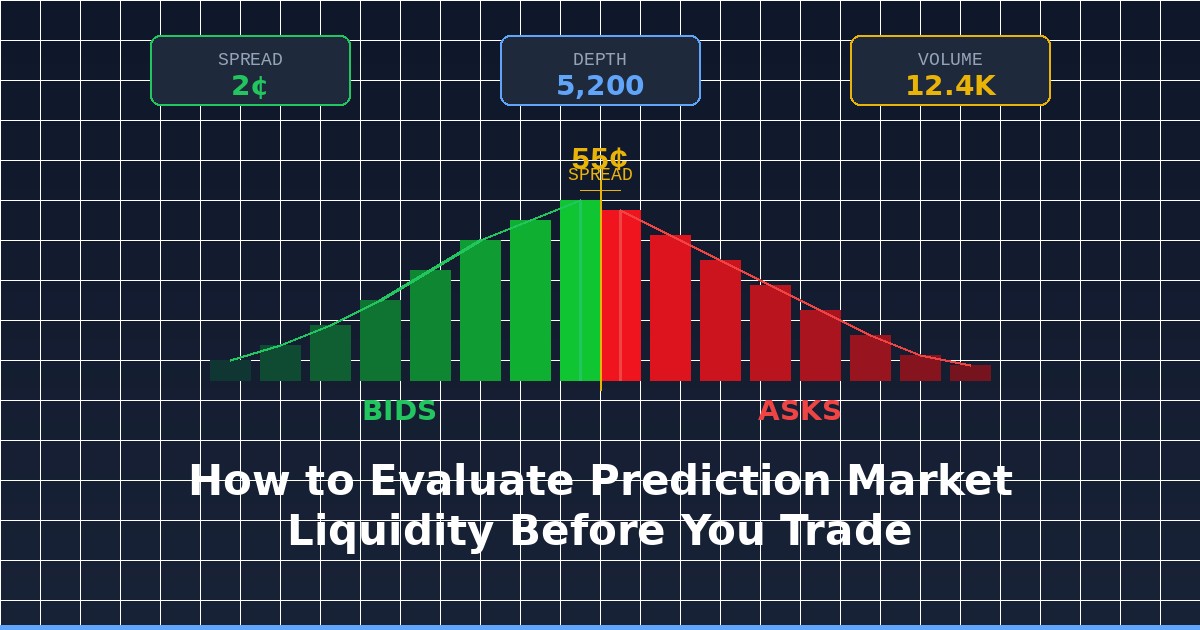
How to Evaluate Prediction Market Liquidity Before You Trade
A practical guide to checking depth, spreads, and fill quality before you commit capital. Stop getting worse prices than you expected.
9 min readRead
Best Crypto Prediction Markets in 2026
Where to trade bitcoin and crypto event contracts in 2026: Polymarket, Kalshi, Limitless, and Myriad compared on regulation, liquidity, and product depth.
4 min readRead
How to Build a Prediction Market Trading Bot (API Guide)
The APIs, SDKs, strategies, and hard-earned lessons behind building automated prediction market trading systems — from first API call to working bot.
11 min readRead