



Polymarket Fees 2026: Calculator & Complete Cost Guide
Polymarket promised 1.8% max fees, but the formula charges up to 7.2% on low-probability crypto markets — the math, V1 vs V3, and how to pay less.
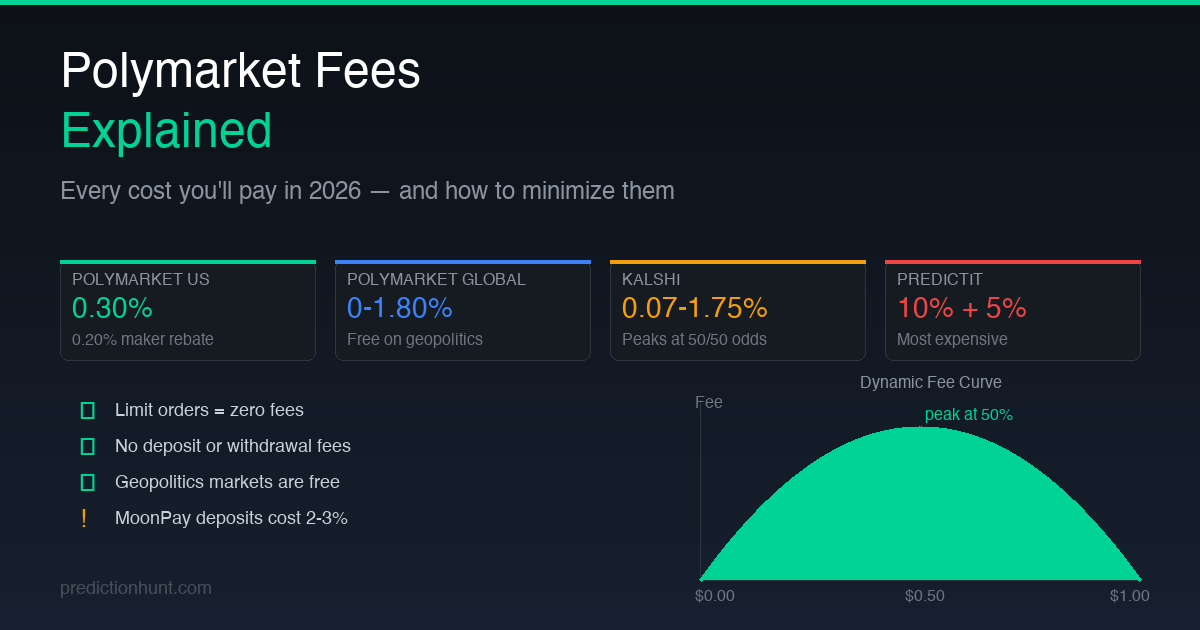
As of March 2026, Polymarket charges taker fees on nearly every market category: Crypto 1.80%, Economics 1.50%, Mentions 1.56%, Culture 1.25%, Weather 1.25%, Finance 1.00%, Politics 1.00%, Tech 1.00%, and Sports 0.75%. Only geopolitics markets remain free. US traders on the regulated exchange pay a flat 0.30% taker fee with a 0.20% maker rebate. Limit orders (maker orders) are free on both platforms.
If you're still operating under the assumption that Polymarket is free to trade, you're leaving money on the table — or more accurately, Polymarket is taking it from yours. This guide breaks down every fee you'll encounter in 2026: what you pay, when you pay it, and how to structure your trades to keep costs as low as possible.
Polymarket's Fee Model: US vs Global
Polymarket now operates two distinct platforms with different fee structures. Which one applies to you depends on where you live.
Polymarket US Exchange
The US exchange, launched after Polymarket acquired CFTC-licensed QCEX in late 2025, uses a straightforward flat-rate model:
| Order Type | Fee |
|---|---|
| Taker (market order) | 0.30% of contract premium |
| Maker (limit order) | -0.20% rebate (you get paid) |
That maker rebate is real money back. Place a limit order for 1,000 contracts at $0.65 and when it fills, you receive a $1.30 rebate instead of paying a fee. The minimum fee or rebate is $0.001 per trade, rounded to the nearest $0.001.
Example: Buy 500 YES shares at $0.60 with a market order. Your cost: 500 x $0.60 = $300 in contracts, plus $0.90 in taker fees. That's 0.30% — barely noticeable on a single trade, but it adds up across hundreds of trades per month.
Polymarket Global (International)
The international platform uses a dynamic taker fee model where your fee depends on two things: the market category and the current share price.
Makers always pay zero fees. If you place a limit order and wait for it to be filled, you pay nothing regardless of category.
Taker fees follow a curve that peaks when the share price is at $0.50 (maximum uncertainty) and approaches zero as the price nears $0.00 or $1.00. The logic: trades at extreme probabilities are less risky for the platform, so they cost less.
Here are the peak taker fee rates by category (what you'd pay at exactly 50/50 odds):
| Market Category | Peak Taker Fee (at $0.50) |
|---|---|
| Crypto | 1.80% |
| Mentions | 1.56% |
| Economics | 1.50% |
| Culture | 1.25% |
| Weather | 1.25% |
| Other / General | 1.25% |
| Finance | 1.00% |
| Politics | 1.00% |
| Tech | 1.00% |
| Sports | 0.75% |
| Geopolitics & World Events | 0% (free) |
If you're trading a political market priced at $0.80, your effective taker fee is significantly lower than the 1.00% peak — the curve tapers off as the price moves away from $0.50.
Geopolitics markets remain completely free to trade for both makers and takers. If you're looking for zero-cost trading, that's where to find it.
The Dynamic Fee Formula (For the Math-Inclined)
Polymarket's international taker fee isn't arbitrary. It follows a published formula:
Fee = C x feeRate x p x (1 - p)^exponent
Where:
- C = number of shares traded
- p = share price (probability)
- feeRate = category-specific rate multiplier
- exponent = curve steepness parameter
The p x (1 - p) component is what creates the bell curve shape. At p = 0.50, the product is 0.25 (maximum fee). At p = 0.90, it drops to 0.09. At p = 0.95, just 0.0475. This means buying shares in high-confidence markets costs a fraction of what you'd pay in a coin-flip market.
Practical implication: If you're buying YES at $0.85 on a political market, your effective fee is roughly 0.26% — not the 1.00% headline rate. The peak rates in the table above only hit at exactly $0.50.
Fees are rounded to 4 decimal places with a minimum charge of 0.0001 USDC per trade.
Deposit Fees
Polymarket charges zero deposit fees. But the path you take to get money onto the platform determines how much you actually pay.
| Deposit Method | Fee | Speed |
|---|---|---|
| USDC from crypto wallet (Polygon) | ~$0.01 gas | Seconds |
| USDC from exchange (Coinbase, Kraken) | Exchange withdrawal fee (varies) | Minutes |
| Debit card via MoonPay | 2-3% processing fee | Minutes |
| Bank transfer to exchange, then USDC | Usually free ACH | 1-3 days |
The cheapest path: buy USDC on an exchange like Coinbase (low or zero fee for the purchase), withdraw it to your Polymarket wallet on Polygon (small network fee), and you're in for under a dollar in total costs. The most expensive path: debit card through MoonPay at 2-3%. On a $1,000 deposit, that's $20-30 gone before you've placed a single trade.
If you're depositing more than a few hundred dollars, the extra step of routing through a crypto exchange saves real money.
Withdrawal Fees
Polymarket charges zero withdrawal fees. The costs you encounter are from the networks and services you use to move funds off-platform:
| Withdrawal Path | Fee |
|---|---|
| USDC to Polygon wallet | Under $0.01 (Polygon gas) |
| Bridge USDC to Ethereum | $1-20+ (Ethereum gas, varies by congestion) |
| Off-ramp USDC to USD via exchange | Exchange-specific (Coinbase: free for bank transfer) |
| MoonPay debit card withdrawal | Processing fee applies |
The cheapest exit: withdraw USDC to your exchange wallet on Polygon, convert to USD, and bank transfer out. Total cost: essentially zero beyond the negligible Polygon gas. Bridging to Ethereum is only necessary if your destination doesn't support Polygon — and Ethereum gas fees fluctuate wildly, so time it during off-peak hours if you can.
Hidden Costs Most Traders Miss
The fees above are the obvious ones. These are the costs that quietly eat your edge:
1. USDC Conversion Costs
If you're starting from USD, you need to convert to USDC somewhere. Most exchanges charge 0-1.5% for this conversion. On-ramp services like MoonPay charge 2-3%. Over the course of a year of active trading with regular deposits, these conversion fees can exceed your actual trading fees.
2. Bid-Ask Spread
The spread — the gap between the highest buy order and the lowest sell order — is a cost you pay on every trade even though it's not labeled as a "fee." On popular markets with deep liquidity, spreads are tight (often 1-2 cents). On niche markets with fewer participants, spreads can blow out to 5-10 cents, effectively adding 5-10% to your round-trip trading cost.
Average Polymarket spreads tightened from roughly 4.5% in 2023 to about 1.2% by late 2025. Still, always check the order book depth before placing large orders.
3. Slippage on Large Orders
If you're buying 10,000 shares on a market with $5,000 of depth at the best price, you won't get the quoted price on all of them. The rest fill at progressively worse prices. For small traders ($50-500 per trade), this is irrelevant. For larger positions, it's a meaningful cost.
4. Opportunity Cost
Funds sitting in USDC on Polygon aren't earning yield elsewhere. If you're holding $10,000 in your Polymarket wallet waiting for the right trade, that capital could be earning 4-5% APY in a savings account or money market fund. Not a "fee" per se, but a real cost of participating.
How to Minimize Your Polymarket Fees
Here's the playbook for keeping costs as low as possible:
1. Use limit orders for everything. Maker orders are free on both US and Global platforms. On the US exchange, you actually get a 0.20% rebate. The only tradeoff is speed — your order might not fill immediately. For most prediction market trades, that patience pays for itself many times over.
2. Deposit USDC directly from a crypto exchange. Skip the debit card on-ramp entirely. Buy USDC on Coinbase or a similar exchange and withdraw to Polygon. You'll save 2-3% on every deposit.
3. Trade liquid markets. Tighter spreads mean lower effective costs. Compare market liquidity across platforms before committing to a trade.
4. Batch your deposits. If you're going to trade $2,000 this month, deposit it once rather than four $500 deposits. Each deposit through a card processor has a minimum fee floor, so batching reduces your per-dollar cost.
5. Check the fee category before trading. On the global platform, geopolitics markets have zero fees. Sports markets charge the least among fee-bearing categories (0.75% peak). Crypto markets are the most expensive (1.80% peak). The same conviction applied to different categories has different cost profiles.
6. Use the fee calculator. Before any trade, plug your numbers into Prediction HuntPrediction.com's fee calculator to see your exact net payout after all platform fees.
Polymarket Fees vs the Competition
How does Polymarket stack up against every other prediction market platform in 2026?
| Platform | Taker Fee | Maker Fee | Withdrawal Fee | Best For |
|---|---|---|---|---|
| Polymarket US | 0.30% flat | -0.20% rebate | Free | Lowest-cost US trading |
| Polymarket Global | 0-1.80% (dynamic) | Free | Free | International, high volume |
| Kalshi | 0.07-1.75% (formula) | Reduced rate | Free (ACH) | US-regulated, sports/politics |
| PredictIt | 10% of profits | 10% of profits | 5% of withdrawal | Avoid if possible |
| Robinhood | ~$0.02/contract | ~$0.02/contract | Free | Casual US traders |
At even odds (50/50 market), on a $100 position:
- Polymarket US: $0.30 fee
- Polymarket Global (politics): ~$0.25 fee
- Kalshi: ~$1.75 fee
- PredictIt: $0 upfront, but 10% of any profit + 5% withdrawal
Polymarket is the cheapest platform for most trade sizes and categories. The only scenario where Kalshi approaches parity is on extreme-probability contracts (above $0.95 or below $0.05) where both platforms charge near-zero.
For how fees stack up against liquidity, funding, and market selection: Polymarket vs Kalshi, the full side-by-side
Recent Fee Changes: 2025-2026 Timeline
Polymarket's fee structure has changed significantly over the past year. Here's the full timeline:
| Date | Change |
|---|---|
| Pre-2025 | Zero trading fees on all markets |
| Early 2025 | Taker fees introduced on 15-minute crypto markets |
| Mid 2025 | Sports markets begin carrying taker fees (0.44% peak) |
| February 2026 | Fees expanded to NCAAB and Serie A soccer markets |
| March 2026 | Polymarket US exchange launches (0.30% taker / 0.20% maker rebate) |
| March 30, 2026 | Major expansion: 8 new categories get fees. Crypto peak raised to 1.80%. Sports to 0.75%. Only geopolitics remains free. |
| March 30, 2026 | Maker rebate program launches with category-specific rebate rates (20-50%) |
| March 30, 2026 | Referral program launches (30% commission on direct referral fees) |
The trend is clear: Polymarket is steadily monetizing its trading volume. Expect more categories to see fee increases over time, and potentially geopolitics markets gaining fees eventually. Plan your trading strategy with rising costs in mind.
How Prediction HuntPrediction.com Accounts for Polymarket Fees
When you see estimated returns on Prediction HuntPrediction.com's Smart Bets, those numbers already factor in Polymarket's fee structure. Our arbitrage scanner and fee calculator use the actual taker fee formula — not a flat estimate — so the returns you see reflect what you'd actually keep after fees.
Use our free fee calculator to compare your net payout across Polymarket, Kalshi, and PredictIt before you commit capital. A 3% edge looks great until fees eat half of it.
Frequently Asked Questions
Does Polymarket charge trading fees?
Yes. Polymarket charges taker fees on market orders that vary by platform and category. On the US exchange, the taker fee is a flat 0.30%. On the global platform, taker fees range from 0% (geopolitics) to 1.80% (crypto) depending on the category and share price. Maker orders (limit orders) are always free on both platforms — and on the US exchange, makers receive a 0.20% rebate.
How much are Polymarket withdrawal fees?
Polymarket itself charges zero withdrawal fees. The only costs are network gas fees when moving USDC off-platform. Polygon withdrawals cost under $0.01. If you need to bridge to Ethereum, gas fees vary from $1 to $20+ depending on network congestion. Off-ramp fees to convert USDC back to USD depend on your exchange.
What is the cheapest way to trade on Polymarket?
Use limit orders exclusively — they're free on both platforms, and on the US exchange you'll earn a 0.20% rebate. Deposit USDC directly from a crypto exchange to avoid MoonPay's 2-3% processing fee. If you're on the global platform, trade geopolitics markets for zero taker fees even on market orders.
How do Polymarket fees compare to Kalshi?
Polymarket is significantly cheaper for most trades. On a $100 position at 50/50 odds, Polymarket US charges $0.30 vs Kalshi's approximately $1.75. The gap narrows at extreme probabilities but Polymarket maintains a cost advantage across nearly all trade sizes and market types.
Does Polymarket charge deposit fees?
No. Polymarket charges nothing to deposit funds. However, third-party payment processors add their own costs. Debit card deposits via MoonPay cost 2-3%. The cheapest route is buying USDC on a crypto exchange and sending it to your Polymarket wallet on Polygon — total cost under $0.01 in gas fees.
Are Polymarket fees different for US and international users?
Yes, substantially. US traders on the regulated exchange pay a flat 0.30% taker fee and receive a 0.20% maker rebate. International traders face a dynamic fee model where rates vary by market category (0% for geopolitics up to 1.80% for crypto) and by share price (fees peak at $0.50 and decrease toward $0.00 and $1.00).
Prediction market trading involves financial risk. This article is for informational purposes only and is not investment or financial advice.
Build with this data
Automate your strategies, create arb bots, or build your own dashboard. Free tier includes 1,000 requests/mo across all prediction market platforms.
Free Trading Tools
View allCompare fees across Kalshi, Polymarket & PredictIt.
Find fair probabilities with the overround removed.
See if a trade has positive EV before you enter.
Convert American, decimal & implied probability.
Combined odds and payouts for multi-leg bets.
Your real take-home after fees and taxes.
Related Posts

Kalshi Fees 2026: Trading, Deposit & Withdrawal Costs
Kalshi's peak taker fee is 1.75%, but most trades cost far less. The full P×(1-P) formula, category-by-category fees, and maker rebates.
9 min readRead
Polymarket vs Kalshi Fees: Which Platform Takes Less?
Polymarket now charges category-based fees up to 1.8%. Kalshi charges up to 1.75%. Opinion has a $0.25 minimum. Full 2026 fee breakdown with examples.
6 min readRead
Best Crypto Prediction Markets in 2026
Where to trade bitcoin and crypto event contracts in 2026: Polymarket, Kalshi, Limitless, and Myriad compared on regulation, liquidity, and product depth.
4 min readRead