


How to Find Kalshi vs Polymarket Arbitrage (2026)
How arbitrage works between Kalshi and Polymarket: the math, negative-risk arbitrage, fees, real risks, and how to scan for opportunities automatically.
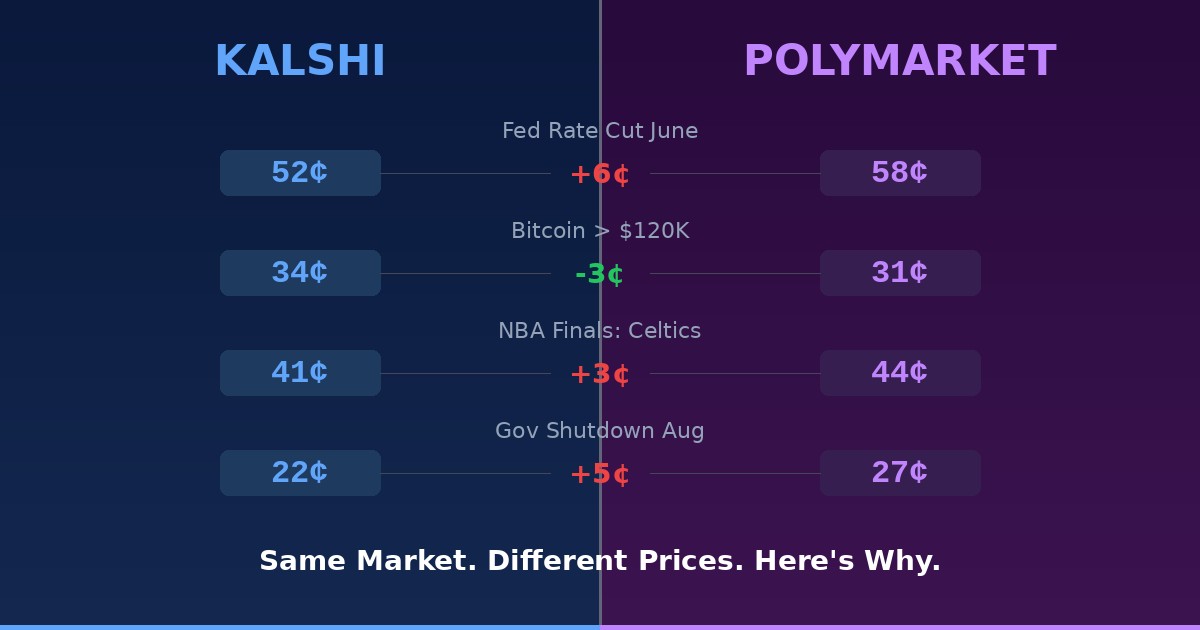
The same question — "Will the Democrats control the House after the 2026 midterms?" — trades simultaneously on Kalshi, Polymarket, and PredictIt. On any given day, those three prices disagree. Sometimes they disagree by enough that you can lock in a profit no matter what happens. That's prediction market arbitrage, and this guide covers the math, the two main flavors, the fees and risks that eat naive arbitrageurs, and how to scan for opportunities systematically. (Still choosing which platform to trade on in the first place? Start with our Polymarket vs Kalshi side-by-side comparison.)
Not financial advice. Arbitrage in prediction markets carries real execution and resolution risk. Understand both before committing capital.
The Core Math: When YES + NO < $1
Every binary prediction market contract pays $1 if it resolves in your favor. So if you can buy YES on platform A and NO on platform B for a combined total under $1, you profit regardless of the outcome.
Example, using real-style numbers:
| Kalshi | Polymarket | |
|---|---|---|
| YES price | 56¢ | 51¢ |
| NO price | 45¢ | 49¢ |
Buy YES on Polymarket at 51¢ and NO on Kalshi at 45¢. Total cost: 96¢ for a guaranteed $1 payout — a 4.2% gross return, no matter what happens. If the event resolves in weeks rather than years, that annualizes well.
The general rule: arb exists when best_yes_ask(A) + best_no_ask(B) < 1.00, after fees.
Flavor 2: Negative-Risk (Multi-Outcome) Arbitrage
Multi-outcome events — "Who will win the 2028 Republican nomination?" — offer a second structure. If the sum of all YES prices across mutually exclusive outcomes exceeds $1, you can sell (or buy NO on) every outcome; if the sum of NO-side pricing lets you cover the full outcome space for under $1, you can lock the spread. Polymarket traders call the related structure "negative risk": buying NO on every candidate in a race where exactly one must win.
Multi-outcome arbs appear more often than binary cross-platform arbs because pricing errors compound across many outcomes — but they need more capital and more fills to close, which multiplies execution risk.
What Kills Naive Arbitrage
The gap you see is not the gap you get. Four things stand between the screenshot and the profit:
1. Fees. Kalshi charges trading fees that peak around 50¢ pricing (roughly 1¢ or more per contract near the middle of the range, less at the extremes). Polymarket's fee structure differs by market. A 3¢ gross edge can be a 0¢ net edge — always compute net of fees. Our fee calculator does this for both platforms.
2. Resolution mismatch. The single most expensive mistake in cross-platform arbitrage. Two markets that look identical can have different resolution criteria, sources, or deadlines. If Kalshi resolves off one source and Polymarket off another, your "riskless" trade can lose both legs. Read the rules on both platforms, every time.
3. Execution slippage. Displayed prices are top-of-book. If your size exceeds the displayed depth, you'll fill at worse prices — and if one leg fills while the other moves away, you're holding a directional position you never wanted.
4. Capital and settlement friction. Your money is locked until resolution. Funds live on separate platforms (one is a regulated US exchange with bank transfers; the other settles in USDC on Polygon). Moving capital between them costs time and fees, which caps how often you can recycle it.
Finding Opportunities: The Hard Part Is Matching
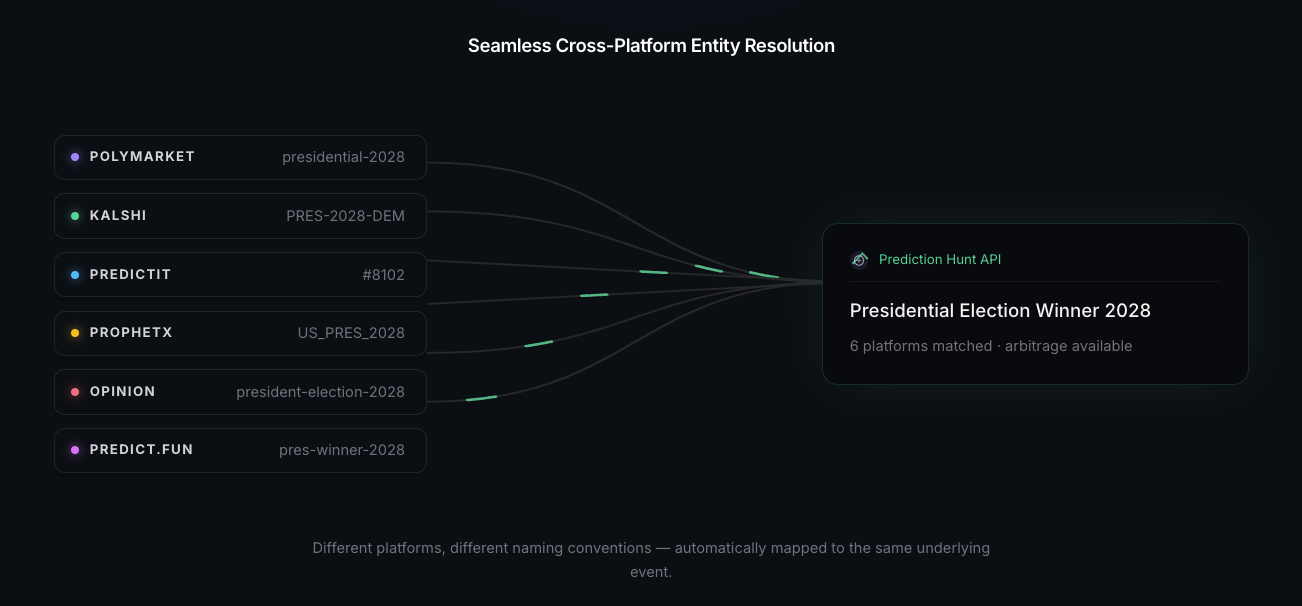
The math is trivial. The hard engineering problem is knowing that Kalshi's PRES-2028-DEM, Polymarket's presidential-2028, and PredictIt's market #8102 are the same event — reliably, across thousands of markets, as new ones launch daily.
You have two options:
Option A: build it. Integrate each platform's API (see our Polymarket and Kalshi guides), normalize the data models, and build entity-matching logic — fuzzy title matching, resolution-criteria comparison, ongoing maintenance as platforms rename things.
Option B: query it. The Prediction HuntPrediction.com API already resolves entities across 6 platforms and computes arbitrage opportunities server-side:
import requests

resp = requests.get(
    "https://prediction.com/api/v2/search",
    params={"q": "house control 2026"},
    headers={"X-API-Key": "YOUR_API_KEY"},
)
event = resp.json()  # one event, prices from every platform that lists it
For continuous monitoring, the Pro tier includes a dedicated arbitrage WebSocket channel that pushes cross-platform opportunities as they appear, plus dedicated arb endpoints. You can also watch opportunities live — no code — on the free Arbitrage Scanner.
A Realistic Workflow
- Scan continuously for
YES(A) + NO(B) < 1net of fees (scanner or WebSocket). - Verify resolution criteria match on both platforms. Skip anything ambiguous.
- Check depth on both books for your intended size.
- Execute the scarcer leg first (the thinner book), then hedge on the deeper book.
- Track locked capital vs. time-to-resolution — a 4% edge over two years is worse than 1.5% over two weeks.
Stop matching markets by hand. Get a free Prediction HuntPrediction.com API key — cross-platform prices with entity resolution built in, plus arb alerts on Pro.
Frequently Asked Questions
Is prediction market arbitrage legal?
Trading on each platform is subject to that platform's terms and your jurisdiction's rules (Kalshi is CFTC-regulated in the US; Polymarket's availability varies by region). Nothing about arbitrage itself is prohibited by the platforms — it's what keeps their prices honest.
How common are real arbitrage opportunities?
Small gaps (1–3¢ gross) appear daily across major events; larger ones appear around fast-moving news, when platforms reprice at different speeds. Net-of-fee opportunities are rarer and close quickly — speed and automation matter.
Do I need a bot to arbitrage prediction markets?
For sub-2¢ edges, effectively yes. For larger, slower dislocations, a scanner plus manual execution works. Start with the free Arbitrage Scanner, automate when you outgrow it.
Build with this data
Automate your strategies, create arb bots, or build your own dashboard. Free tier includes 1,000 requests/mo across all prediction market platforms.
Free Trading Tools
View allCompare fees across Kalshi, Polymarket & PredictIt.
Find fair probabilities with the overround removed.
See if a trade has positive EV before you enter.
Convert American, decimal & implied probability.
Combined odds and payouts for multi-leg bets.
Your real take-home after fees and taxes.
Related Posts
Case Study: Maximizing Alpha in Prediction Markets
How Elastics uses the Prediction HuntPrediction.com Market Matching API as a smart order router to automate trading across Kalshi, Polymarket, PredictIt and more.
3 min readRead
Best Crypto Prediction Markets in 2026
Where to trade bitcoin and crypto event contracts in 2026: Polymarket, Kalshi, Limitless, and Myriad compared on regulation, liquidity, and product depth.
4 min readRead
Prediction Market Indices: How Event Contract Indexes Work
What a prediction market index is, how Kalshi's political power index works, where equity index perps fit in, and whether a prediction market ETF exists yet.
4 min readRead